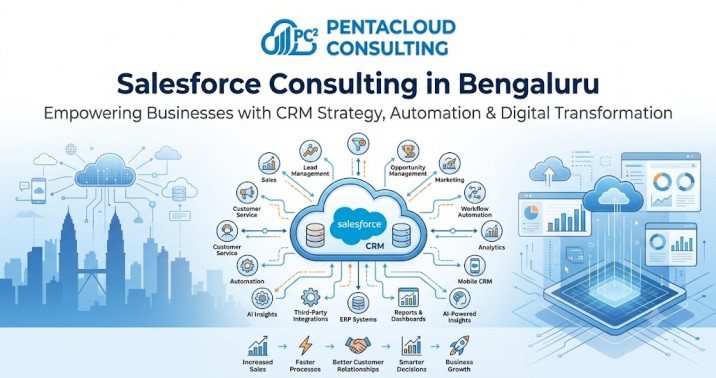
Salesforce consulting in Bengaluru has become the primary growth engine for Indian startups, tech entrepreneurs, and small-to-medium enterprise (SME) owners looking to scale their operations. Managing a growing firm with annual revenues between ₹50 Lakhs and ₹50 Crores brings distinct organizational hurdles. Your sales data gets scattered across multiple spreadsheets, tracking customer interactions becomes chaotic, and your sales team loses valuable hours on manual entry instead of closing deals. Recent industry data shows that Indian mid-market firms using centralized cloud platforms experience a 32% faster revenue growth rate compared to those stuck with legacy systems. This comprehensive guide outlines how local businesses utilize cloud investments to build scalable operations, maximize customer retention, and drive predictable sales pipelines. At Pentacloud Consulting, we bridge the gap between enterprise-grade capabilities and startup accessibility, providing tailored systems that fit your operational budget.
Why Indian Startups Choose Salesforce Consulting in Bengaluru
Indian startups operate in a high-velocity environment where agility determines survival. Choosing regional Salesforce consulting in Bengaluru provides direct access to localized tech expertise that understands the unique pressures of the Indian market. Founders frequently discover that basic customer management tools fail as soon as transaction volumes surge. When your business processes expand, you need a system that grows alongside you without breaking.
Navigating the Local Business Reality
Bengaluru’s startup culture values speed, but it also demands fiscal prudence. Local engineering talent knows how to build lean systems. A local cloud partner understands that an Indian SME cannot simply replicate a Western software setup. You face distinct regional challenges like managing multi-location teams across Tier 1 and Tier 2 cities, handling fluctuating internet bandwidth, and operating within tight capital constraints.
The Power of Proximity and Cultural Fluency
Working with a regional partner ensures your implementation team shares your business context. They understand the extended negotiation timelines typical in Indian B2B markets. They know how Indian field sales representatives operate on the ground. This cultural alignment means shorter briefing cycles, fewer operational misunderstandings, and a system built around your actual day-to-day workflow.
5 Essential Pillars of Salesforce Consulting in Bengaluru
To achieve maximum value from your platform investment, you must focus on five core implementation pillars. Successful deployment requires more than simply turning on user licenses. It demands a deliberate alignment of your business strategy with cloud architecture.
+-----------------------------------------------------------------+
|               PENTACLOUD'S 5-PILLAR ARCHITECTURE                |
+-----------------------------------------------------------------+
|  1. LOCAL TRADING STACK INTEGRATION (Tally, Razorpay, WhatsApp) |
|  2. COMPREHENSIVE DATA SECURITY (GST, Digital Personal Data)   |
|  3. TAILORED WORKFLOW AUTOMATION (Lead Routing, Approvals)      |
|  4. CUSTOMIZED PROGRESSION METRICS (Pipeline, Conversion)       |
|  5. STRUCTURED TEAM ENABLEMENT (Role-Specific Training)         |
+-----------------------------------------------------------------+
1. Integrating the Local Technology Stack
Your customer platform cannot exist in isolation from your core financial systems. A successful deployment requires direct integration with the software tools that run Indian commerce.
- Financial and Accounting Systems: Your setup must connect with Tally or Zoho Books to sync invoices, outstanding balances, and customer credit limits.
- Payment Gateways: Integration with Razorpay, Paytm, or PayU allows your sales team to view payment statuses directly within the customer profile.
- Primary Communication Channels: Connecting WhatsApp Business API directly to your customer records ensures real-time tracking of conversations, payment alerts, and delivery updates.
2. Maintaining Strict Regulatory Compliance
Operating a business in India means adhering to evolving local compliance rules. Your system must be configured to handle these frameworks accurately from day one.
- GST Compliance Requirements: Your system must automate Goods and Services Tax calculations across different states, tracking Central GST, State GST, and Integrated GST based on delivery locations.
- Data Localization Considerations: Under current Indian regulations, financial and sensitive user data must reside on local servers. Your consulting partner ensures your cloud storage settings comply with these statutory mandates.
3. Automating Operational Workflows
Manual data movement slows your organization down. Automation preserves your team’s energy for revenue-generating activities.
- Lead Routing: Automatically assign incoming inquiries from your website, IndiaMART, or TradeIndia to the correct regional sales representative based on pin codes or product categories.
- Approval Matrices: Build automated discount approval loops. If a sales executive offers a discount above 15%, the system immediately routes the request to the regional head via mobile notifications.
4. Designing Customized Progression Metrics
Generic reporting dashboards rarely provide actionable business intelligence. Your analytics must reflect your precise key performance indicators.
- Pipeline Visibility: Track your sales funnel from initial contact to final contract signature, identifying where bottlenecks occur.
- Conversion Rates: Measure the performance of individual marketing campaigns, specific product lines, and distinct sales teams to understand where your revenue originates.
5. Establishing Structured Team Enablement
Software provides no value if your employees refuse to use it. A deliberate change management strategy prevents low adoption rates.
- Role-Specific Instruction: Train your field staff exclusively on the mobile interface they use on the road, while providing your operations team with deep training on desktop dashboards.
- Continuous Evaluation: Conduct regular usage audits during the first 90 days to identify users who are struggling with the new system.
Cost Analysis of Salesforce Consulting in Bengaluru
Understanding deployment economics helps you avoid budget overruns. For an Indian SME earning between ₹50 Lakhs and ₹50 Crores, capital allocation must be precise. The overall cost of cloud transformation depends on user count, data complexity, and integration requirements.
Understanding Core Budget Allocations
A standard deployment involves software licensing fees and professional service fees. While licensing costs remain relatively fixed based on your selected tier, professional service fees depend on your partner’s engagement model.
+-------------------------------------------------------------------------+
|                  PROJECT TYPE & INVESTMENT BENCHMARKS                   |
+-------------------------------------------------------------------------+
| Startup Setup (Standard Sales/Service Cloud, Basic Setup)               |
| Investment: ₹5L – ₹20 Lakhs                                            |
| Timeline: 4 – 6 Weeks                                                   |
+-------------------------------------------------------------------------+
| SME Implementation (Custom Apps, ERP Integration, Multi-Cloud)         |
| Investment: ₹20L – ₹2 Crores                                            |
| Timeline: 3 – 5 Months                                                  |
+-------------------------------------------------------------------------+
| Enterprise Deployment (Deep Legacy Systems, High Customization)        |
| Investment: ₹2 Crores+                                                  |
| Timeline: 6+ Months                                                     |
+-------------------------------------------------------------------------+
The Regional Cost Advantage
Partnering with a specialized team in Bengaluru offers a substantial financial advantage. Western and Middle Eastern enterprises regularly pay high hourly development rates. By utilizing a partner with deep local roots, Indian SMEs gain a 40% to 60% cost advantage compared to hiring Dubai or Western-based consulting partners. This price efficiency allows you to reallocate precious capital toward product development, talent acquisition, or performance marketing.
Common Mistakes and Expert Warnings in Cloud Deployments
Over our years of implementing enterprise technology, we have watched numerous firms stumble over the same hidden obstacles. Recognizing these red flags early saves millions of rupees and months of wasted effort.
Falling Into the Over-Customization Trap
The most common mistake is attempting to recreate your old, broken manual processes inside a modern cloud environment. When you force a new system to mimic legacy habits, you create an unstable architecture that breaks during future platform updates. The reality: adapt your operational workflows to match industry best practices already built into the platform, rather than writing thousands of lines of fragile custom code.
Neglecting Post-Implementation Upkeep
We often see projects stumble because a business assumes that going live marks the end of the journey. A platform left unmanaged quickly accumulates duplicate data, broken automations, and out-of-date user permissions. You must plan for ongoing support. Whether you use an internal administrator or a flexible monthly consulting retainer, your system requires regular maintenance to stay aligned with your shifting business goals.
Strategic Evaluation: Choosing Your Consulting Partner
Selecting a service provider shapes your firm’s operational future. You need a partner who views technology through a business lens, rather than just a technical one. Use Pentacloud’s 7-Point Matrix to evaluate potential technology partners before signing a contract.
+-------------------------------------------------------------------------+
|                    PENTACLOUD'S 7-POINT MATRIX                          |
+-------------------------------------------------------------------------+
|  1. CERTIFICATION DEPTH: Verified developer and architect credentials   |
|  2. INTEGRATION EXPERIENCE: Documented history with Tally, ERPs, APIs   |
|  3. REGIONAL FLUENCY: Clear understanding of Indian business dynamics    |
|  4. ENGAGEMENT FLEXIBILITY: Project-based, retainer, or hybrid models  |
|  5. METHODOLOGY TRANSPARENCY: Defined sprints with clear deliverables   |
|  6. ACCESSIBLE EXPLANATIONS: Ability to explain code in business terms  |
|  7. POST-LIVE COMMITMENT: Defined SLA terms for long-term support       |
+-------------------------------------------------------------------------+
Reviewing Technical Credentials and Real Experience
Do not focus solely on the absolute number of certificates on a company brochure. Look closely at the practical depth of those certifications. A firm boasting twenty introductory administrator certificates may lack the deep engineering knowledge required to handle complex data migrations or API integrations. Ask for concrete examples: “Can you walk us through how you integrated a custom sales application with an ERP system for a manufacturer in Pune or a logistics firm in Mumbai?” Demand detailed descriptions of actual problems solved, rather than high-level theoretical overviews.
Examining Engagement Flexibility
Your business needs change rapidly. A rigid contractual model can stifle an early-stage company. Ensure your partner offers agile engagement models, including clear project-based pricing for initial rollouts, dedicated monthly support retainers for optimization, and hybrid frameworks for sudden scaling needs.
Maximizing Value From Your System Infrastructure
A successful deployment acts as a foundation for long-term business transformation. Once your sales and customer service teams operate on a single system, you can explore advanced automation, predictive analytics, and targeted performance marketing campaigns.
Driving Growth with Clean Customer Data
When you centralize your customer interactions, your marketing efforts become far more accurate. Instead of sending generic email blasts to your entire database, you can segment your customers based on their historical purchase values, precise geographic locations, or specific product interests. This targeted approach increases your conversion rates while lowering your overall customer acquisition costs.
Empowering Management with Real-Time Visibility
For business owners managing operations across major Indian cities like Bengaluru, Delhi NCR, and Hyderabad, real-time dashboard tracking completely changes how decisions are made. You no longer need to wait for weekly or monthly status reports from your regional managers. You can view your true operational metrics, pipeline risks, and revenue projections directly from your phone at any hour of the day.
Scaling Clean Operations with Salesforce Consulting in Bengaluru
Transitioning from chaotic spreadsheets to an organized cloud environment requires clear technical strategy, deep local business insights, and an ongoing commitment to training your team. By focusing on essential integrations, respecting local compliance rules, and avoiding excessive customization, your business can build an operational engine that supports sustained revenue growth.
Pentacloud Consulting specializes in delivering this exact balance. We provide end-to-end cloud infrastructure solutions, strategy development, comprehensive implementation support, and ongoing administrator enablement. We help ambitious Indian SMEs build the high-performing platforms they need to compete globally while keeping deployment costs highly efficient.
If you are ready to remove data silos, automate repetitive operational tasks, and gain clear visibility into your true sales pipeline, your next step is straightforward. Review your current software license usage, list your most critical system bottlenecks, and consult with a specialist who understands the realities of local business operations. Contact our team today at https://pentacloudconsulting.com/ to schedule your comprehensive operational health check. Let us structure a clear, reliable path toward scaling your business through expert Salesforce consulting in Bengaluru.
Ready to Modernize Your Cloud Architecture?
Connect with Pentacloud Consulting’s certified systems engineering team to run an exhaustive, data-backed operational assessment of your CRM ecosystem.
Request Architecture Discovery Session