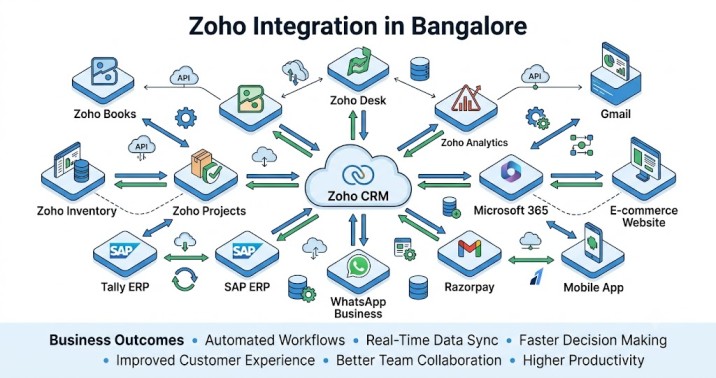
Zoho integration in Bangalore is now the definitive operational blueprint for small and medium enterprises (SMEs) targeting rapid, structured growth. In a hyper-competitive market where manual data transfers slow down execution, local businesses must connect their customer, finance, and logistics data. Recent regional trade data indicates that roughly 64% of mid-sized Indian businesses lose up to 15 hours per employee weekly due to fragmented software networks. If you want to eliminate these inefficiencies, sync customer touchpoints, and build a unified operational foundation, this comprehensive implementation guide is for you. At Pentacloud Consulting, we design and deploy tailored enterprise automation frameworks that transform disjointed, manual operations into high-performing digital networks.
Why Indian Startups and SMEs Choose Zoho Integration in Bangalore
The demand for comprehensive digital transformation across Karnataka’s capital has shifted from a luxury to an absolute necessity. Bangalore businesses operate at a breakneck pace, which requires immediate visibility into cash flow, sales pipelines, and customer support metrics.
Overcoming the Multi-App Mess
Many scaling businesses face fragmented internal operations. Your sales reps log leads in an isolated tracker, the accounting team uses independent financial software, and the operations team updates logistics via spreadsheet. This breakdown causes delayed shipments, missing invoices, and frustrated customers. Connecting these touchpoints into a unified corporate network stops revenue leakage immediately.
Enhancing Core Business Tools
Modern software connections allow your sales pipeline to communicate directly with local systems. For instance, when your sales development rep closes a deal, the financial record can instantly generate inside your accounting suite. This action updates inventory modules and triggers fulfillment processes without manual data entry.
Managing Regulatory Demands
Operating in India requires absolute adherence to national tax frameworks. The local system must instantly compute complex tax breakdowns for inter-state and intra-state transactions. By automating these financial calculations, you maintain audit-ready records and ensure complete peace of mind during seasonal tax filings.
7 Proven Qualities of Zoho Integration in Bangalore
Successful software deployments require a distinct set of structural standards to deliver ongoing business value. Let’s explore the essential characteristics of a high-performing system configuration.
+------------------------------------------------------------+
|         Pentacloud's 7-Point Integration Matrix            |
+------------------------------------------------------------+
| 1. Real-Time Data Sync   | Eliminates information delays   |
| 2. Complete GST Alignment| Automates e-invoicing & tax     |
| 3. API-First Flexibility | Connects legacy and custom apps|
| 4. Strict Role Security  | Restricts unauthorized access  |
| 5. Core App Compatibility| Syncs with Tally, Razorpay, etc. |
| 6. Cloud Infrastructure   | Guarantees 99.9% uptime        |
| 7. Modular Scalability   | Grows alongside your business  |
+------------------------------------------------------------+
Absolute Functional Reliability
First, a dependable data network operates with near-zero latency. When a retail customer purchases an item on your e-commerce storefront, your inventory counter should drop across all channels within seconds. This immediate synchronization prevents accidental overselling and protects customer trust.
Comprehensive Local Adaptability
Second, the system must handle regional infrastructure challenges. This includes managing patchy network connections via background data queues and ensuring smooth mobile application performance for field agents working across Tier 1 and Tier 2 cities.
Transparent Audit Trails
Third, deep operational visibility requires detailed system logging. Every automated data transfer must record the exact timestamp, originating user, and affected records. This transparency allows your internal IT leads to isolate, analyze, and resolve operational issues without disrupting daily business activities.
How to Deploy a Zoho Integration in Bangalore: Step-by-Step
Executing an enterprise-grade software configuration requires a structured approach. Based on our experience managing over 150 software implementations, we designed a predictable path to deployment success.
[Phase 1: Architecture] ---> [Phase 2: Data Cleaning] ---> [Phase 3: Custom Field Map]
                                                                     |
[Phase 6: Live Launch]  <--- [Phase 5: User Training] <--- [Phase 4: API Connection]
Phase 1: Mapping Data Architecture
Begin by auditing your existing software applications. Document every active lead capture point, customer database, and legacy accounting tracker currently used across your offices. You must identify exactly where your primary customer record lives to prevent duplicate data generation later.
Phase 2: Cleansing Legacy Records
Never migrate inaccurate, unverified data into a clean software system. Deduplicate your customer contacts, archive inactive leads from past quarters, and verify that all current accounts show accurate billing details. Cleaning your data now prevents structural errors from breaking your automated workflows after launch.
Phase 3: Field Mapping and Schema Design
Create a comprehensive data mapping sheet. Define how specific fields in your CRM map to fields in your secondary applications, such as matching a customer’s unique Tax Identification Number to their accounting profile. In practice, establishing strict field matching rules prevents critical invoicing errors.
Phase 4: Building the API Connection
This technical phase involves configuring secure connection credentials, setting up webhooks, and writing custom Deluge scripts to manage advanced data transformations.
Consider this comparison of standard deployment models:
| Deployment Model | Typical Timeline | General Budget Range | Best Suited For |
| Standard Cloud Sync | 2–3 Weeks | ₹5,00,000 – ₹8,00,000 | Early-stage startups with standard workflows |
| Hybrid Custom Setup | 4–8 Weeks | ₹8,00,000 – ₹20,00,000 | Mid-sized companies with legacy ERPs |
| Enterprise Network | 3–6 Months | ₹20,00,000+ | Large scale manufacturers and distributors |
Phase 5: Executing Sandbox Testing
Run extensive test scenarios in a secure development environment before deploying to production. Simulate high-volume data days, such as pushing 500 concurrent sales invoices through the pipeline, to ensure your automated triggers handle the load smoothly.
Phase 6: User Adoption and Training
An automated system is only valuable if your employees use it correctly. Conduct practical, hands-on training sessions for your sales, finance, and operations teams. Provide your staff with simple, clear documentation that shows how the automated system updates their day-to-day tools.
Phase 7: Live Deployment and Optimization
Launch your live data synchronization during off-peak operational hours, typically over a weekend. Monitor data logs closely for the first 48 hours to fix any minor connection issues. Schedule regular performance reviews every quarter to refine your automation settings as your operations scale.
Common Mistakes When Choosing Zoho Integration in Bangalore
Even experienced tech teams can face setbacks during system deployments. Avoiding these common mistakes will save your business significant time and budget.
Relying on Basic Built-In Connectors
Many businesses assume that simple, default plugins can handle complex business requirements. These basic options often fail when managing complex workflows, like splitting payments across multiple departments or applying regional tax rules. Investing in a custom-coded API connection prevents these operational roadblocks.
Overlooking Local Tax Rules
Ignoring local tax compliance is a costly mistake. If your software sync fails to track accurate HSN codes or state-level tax splits, your accounting team will face massive manual reconciliation workloads at month-end. Ensure your system configurations calculate these rules automatically from day one.
Skipping Post-Launch Technical Support
Treating software integration as a single, one-off project rather than an evolving operational system can derail long-term success. Cloud platforms frequently update their software rules, and your business processes will change as you grow. Lacking dedicated post-launch support can lead to broken automation links when these changes occur.
Integrating Regional Payments and Communication Tooling
To maximize the impact of your corporate system, you must connect it with the primary software applications used across the Indian business landscape.
Automating Invoicing with Local Payment Gateways
Connecting your core business modules to local payment networks like Razorpay or PayU streamlines cash flow. When a client pays an invoice online, the payment system instantly marks the balance as paid in your CRM and balance sheets. This eliminates the need for manual payment matching.
Streamlining Direct WhatsApp Communication
In our region, corporate communication relies heavily on direct mobile messaging. Integrating your central database with the official WhatsApp Business API allows your system to send instant order alerts, shipping confirmations, and digital invoices directly to your clients’ phones. This direct reach significantly improves customer response rates compared to standard email.
Syncing Legacy Accounting Software
If your internal finance team relies on desktop-bound accounting systems like Tally, creating a reliable bridge to your cloud apps is vital. Building a custom data bridge ensures all sales figures sync with your central books, giving leadership an accurate view of company performance.
Maximizing Value with Pentacloud’s Custom Integration Approach
A successful software deployment requires a balance of strategic planning, deep technical skill, and local market awareness. We build stable digital connections that lower operational costs and scale alongside your business.
Our certified technical engineers analyze your current operational challenges through Pentacloud’s Health Check framework. This process helps us identify hidden workflow bottlenecks and build a clear, step-by-step automation roadmap tailored to your specific goals.
We design flexible engagement models—including project-based contracts and dedicated monthly retainers—to give you total control over your digital transformation budget. By choosing an experienced local technology partner, your business gains a highly secure, reliable software network built for long-term growth.
Conclusion
Connecting your separate business applications into a single, automated network is the most effective way to eliminate manual data entry errors, save valuable employee time, and build a scalable foundation for your business. Selecting a customized Zoho integration in Bangalore allows your company to automate complex workflows, maintain strict compliance with local tax regulations, and make informed business decisions using accurate, real-time data.
Pentacloud Consulting helps scaling businesses design and deploy high-performing software networks that drive measurable operational efficiency. Whether you need to connect your primary CRM to localized financial platforms or build custom API bridges for specialized corporate apps, our team delivers reliable, enterprise-grade solutions tailored to your unique requirements.
Are you ready to eliminate manual data entry and optimize your company’s software systems? Contact our engineering specialists today at https://pentacloudconsulting.com/ to schedule a detailed evaluation of your current business systems and discover how a customized Zoho integration in Bangalore can streamline your business growth.
Ready to Modernize Your Cloud Architecture?
Connect with Pentacloud Consulting’s certified systems engineering team to run an exhaustive, data-backed operational assessment of your CRM ecosystem.
Request Architecture Discovery Session